Intense Yellow Citrine points to color. High-Clarity Citrine emphasizes a clean, transparent appearance. Brazilian Citrine introduces a claim about origin. These plain-English translations of the source labels answer different questions, so they cannot be read as steps on one quality scale. [1][6]
Clara Crystal puts it simply: “Darker yellow does not automatically mean better citrine.” Her post draws attention to how color, transparency, and internal texture work together. [1]
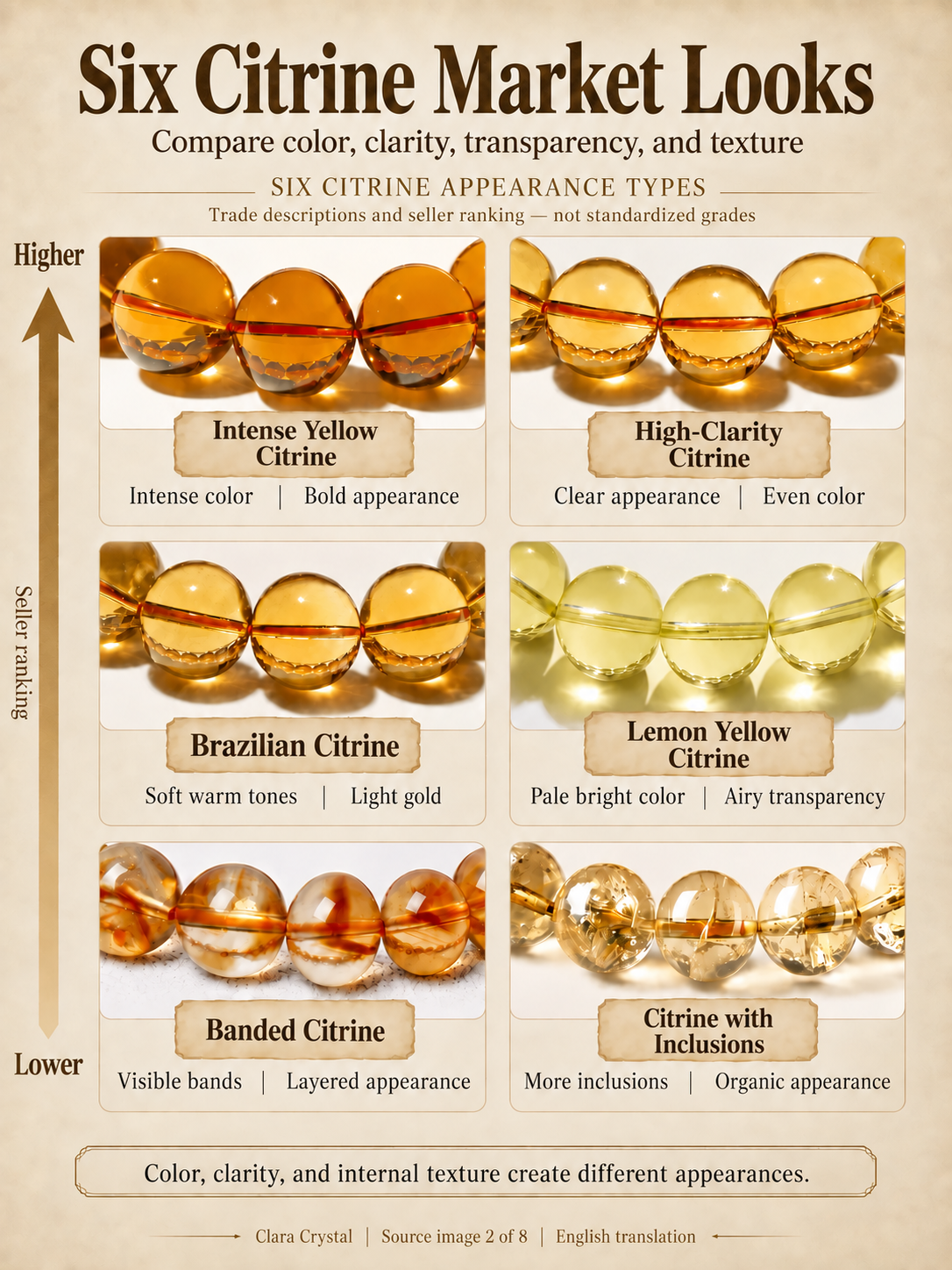
Read the label by what it describes
GIA defines citrine as the transparent yellow to brownish orange variety of quartz. A market nickname adds a description or a sales claim; it does not replace the material’s identity. [4]
Swipe or scroll across to see all four columns.
| Market name | Appearance in the posts | Main dimension | What it does not establish |
|---|---|---|---|
| Intense Yellow Citrine | Saturated golden yellow or orange-yellow | Color | Natural color, treatment history, or an official grade |
| High-Clarity Citrine | Clean, transparent, and evenly colored | Clarity and appearance | Natural origin or freedom from microscopic inclusions |
| Brazilian Citrine | Soft gold or honey tones | Origin claim and color | Verified Brazilian origin or superior quality |
| Lemon Yellow Citrine | Pale, bright yellow | Color | How the color was produced |
| Banded Citrine | Visible bands and layers | Internal pattern | A separate mineral species or untreated status |
| Citrine with Inclusions | More visible inclusions and cloudy features | Internal appearance | A verified locality or the identity of the inclusions |
Color and clarity can overlap
A deeply colored bead can also look clean. These terms need not describe mutually exclusive groups. GIA considers color and clarity separately when discussing citrine quality. It also notes that much faceted citrine is eye-clean, meaning no inclusions are visible to the unaided eye. That does not mean nothing would be visible under magnification. A clean appearance alone is therefore not evidence that a stone is artificial. [5]
Brazilian is an origin claim
CIBJO’s naming guidance reserves geographic names for the place where a gemstone was mined or harvested and states that origin does not imply quality. Ask what supports “Brazilian” in a particular listing. The soft golden look described in these posts cannot, by itself, establish a country of origin. [6]
Material and treatment are separate questions
Ziling Zhijing’s comparison places lab-grown quartz, glass, treatment labels, and market names side by side. It shows why the first question should be what the item is made of. The next question is whether its color has been changed. [2]
GIA describes heating amethyst to produce citrine color. Heat treatment is a process; lab-grown describes how a crystal was produced. Glass is an imitation material. “Intense Yellow Citrine” alone answers none of those questions. [6][7]

How to read a seller ranking chart
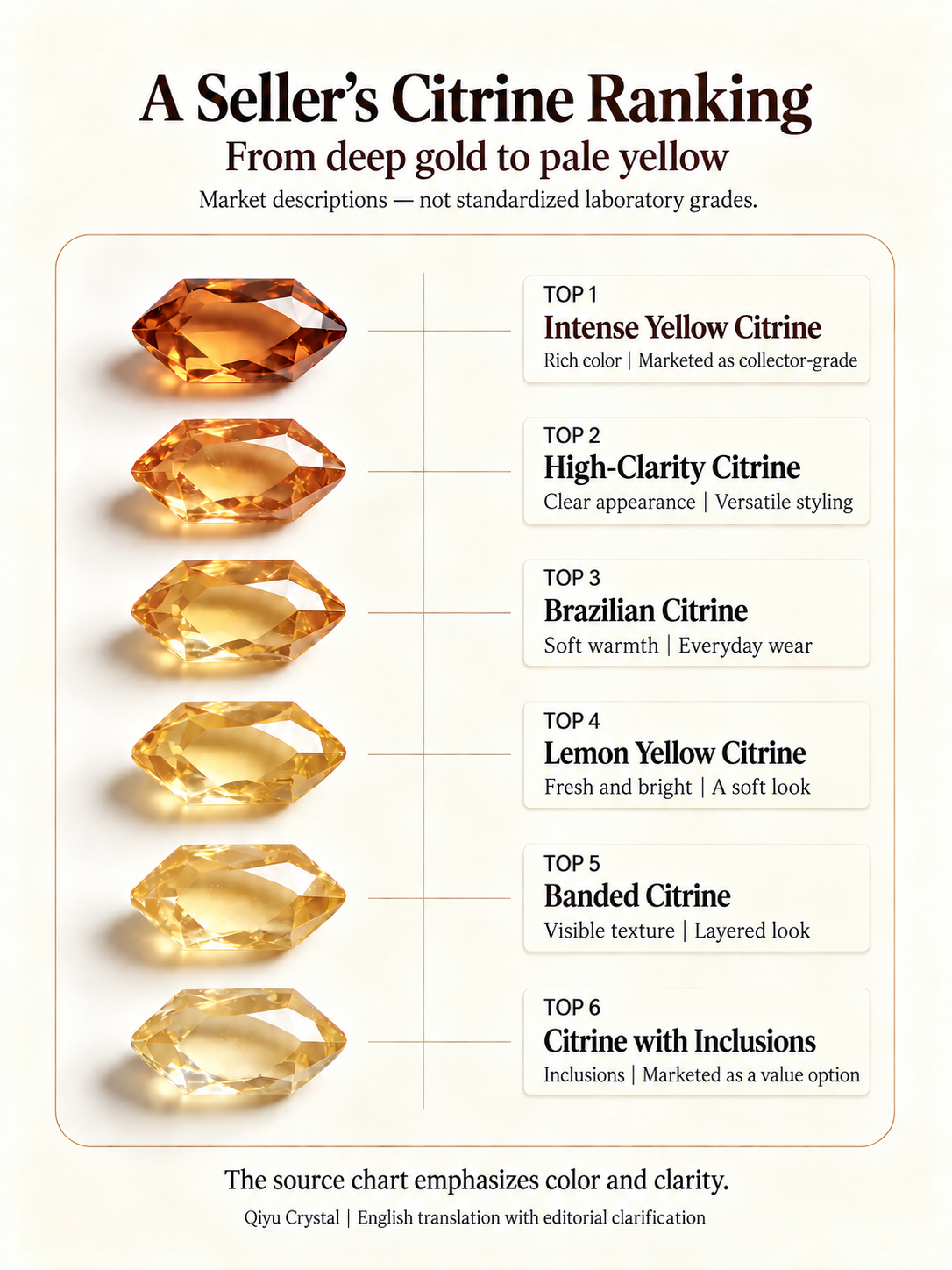
Qiyu Crystal ranks Intense Yellow Citrine above High-Clarity Citrine, followed by Brazilian Citrine and other names. The chart combines color, clarity, and market positioning. Read “collector-grade” as the seller’s description unless a defined grading system and its criteria are provided. The ranking does not demonstrate rarity, origin, or treatment status. [3][5][6]
What buyers are asking in the comments
What sellers mean by intense yellow
One reader under Clara’s post asks whether a pictured bead fits that name. The useful follow-up is to ask the seller which color range they mean and to show the actual item under neutral lighting. Agreement on a nickname is not a gem identification. [1][4]
Whether Brazilian Citrine justifies the asking price
Another reader mentions a seller’s quote of RMB 40 per gram for an item described as Brazilian. This is one reported quote, not a market price guide. Before comparing offers, ask for the item’s weight, bead diameter, condition, treatment disclosure, and basis for the origin claim. The word “Brazilian” cannot supply those details. [1][6]
Whether a photo can settle authenticity
In the comments on Ziling Zhijing’s post, the author declines to assess a livestream image because beauty filters may mislead the buyer. In another reply, the author asks for a white-background, backlit photo. Better images can help a buyer compare appearance, but that still leaves material identity and treatment to be established. [2]
GIA’s colored stone identification reports describe material identity and detectable treatments. That wording matters: a report’s conclusions are limited to the item examined and the findings it can make. Ask the issuing laboratory whether its service addresses the specific treatment or origin claim you care about. [8]
Questions to ask before buying
- What mineral or material is this, and is it natural or lab-grown?
- What do you mean by this market name: color, clarity, an origin claim, or a defined grade?
- Has it been heated, irradiated, dyed, or otherwise treated? What is known, and what remains unknown?
- If it is described as Brazilian, what evidence supports that origin?
- Does “clean” mean clean to the naked eye, or under magnification? Can I see the actual beads in neutral lighting?
- If there is a report, does it match this item, and what does it actually conclude about identity and treatment?
Choose the appearance you enjoy, then verify the claims that matter to you. A useful market name should make a conversation with the seller more precise. It should not take the place of that conversation.
Sources and image credits
Xiaohongshu source posts and the gemological references cited in this article are listed below with plain-text source addresses. The English labels describe the appearance or origin claims in the Chinese source posts. They are descriptive translations, not standardized gemological grades.
[1] Clara Crystal on six citrine market lookshttps://www.xiaohongshu.com/explore/6a3a5e97000000001603dbdb
Xiaohongshu post by Clara Crystal. Appearance descriptions, figure 1, and reader questions.
[2] Ziling Zhijing on citrine labels and buyer questionshttps://www.xiaohongshu.com/explore/6a7b2dcd0000000025017a7d
Xiaohongshu post by Ziling Zhijing. Figure 2 and comments about photographs.
[3] Qiyu Crystal and the seller ranking charthttps://www.xiaohongshu.com/explore/6a5f426a000000000f01e97e
Xiaohongshu post by Qiyu Crystal. Figure 3 and the seller’s ranking.
[4] GIA Citrine Descriptionhttps://www.gia.edu/citrine-description
Definition of citrine as a quartz variety.
[5] GIA Citrine Quality Factorshttps://www.gia.edu/citrine-quality-factors
Separate discussion of color and clarity, including eye-clean faceted citrine.
[6] CIBJO The Gemstone Book dated December 22 2022https://cibjo.org/wp-content/uploads/2023/01/22-12-22-Official-Gemstone-Book.pdf
Sections 3.1–3.2 and 4.2.3–4.2.4 on material categories, geographic names, and nomenclature.
[7] GIA An Introduction to Gem Treatmentshttps://www.gia.edu/gem-treatment
Heating as a treatment and the amethyst-to-citrine example.
[8] GIA Sample Colored Stone Reportshttps://www.gia.edu/analysis-grading-sample-report-colored-stone
Identification reports and the scope of detectable treatment findings.