Two yellow bracelets can look similar and carry very different price tags. In a Xiaohongshu post, JING starts with exactly that frustration. The author’s most useful advice is simple: “The most important thing is knowing what you’re buying.” [1]
Start with what is actually being offered: color, clarity, bead size, weight, treatment disclosure, and construction. A shared name or similar photo does not establish that two bracelets are comparable. The questions below turn those missing details into a practical comparison.

Start with color and clarity
Look beyond how yellow it is
One Xiaohongshu buying guide focuses on rich color, grayish tones, and uneven patches. These observations are useful; its unsupported price tiers cannot establish a current value. [2]
GIA discusses both saturated yellow to reddish orange and the appeal of earthy orange shades. Color preference is not a single ladder from pale to dark. Compare the actual items under similar lighting, recording the hue, depth, and evenness you see. [4]
Describe what clean means
The same guide highlights cracks, dark spots, and cloudy areas. Request close views of the beads. [2]
GIA notes that much faceted citrine is eye-clean: inclusions are not visible to the unaided eye. A clean appearance therefore does not, by itself, establish that a stone is synthetic. Ask whether a clarity claim refers to normal viewing or magnification. [4]
Check the treatment claim separately
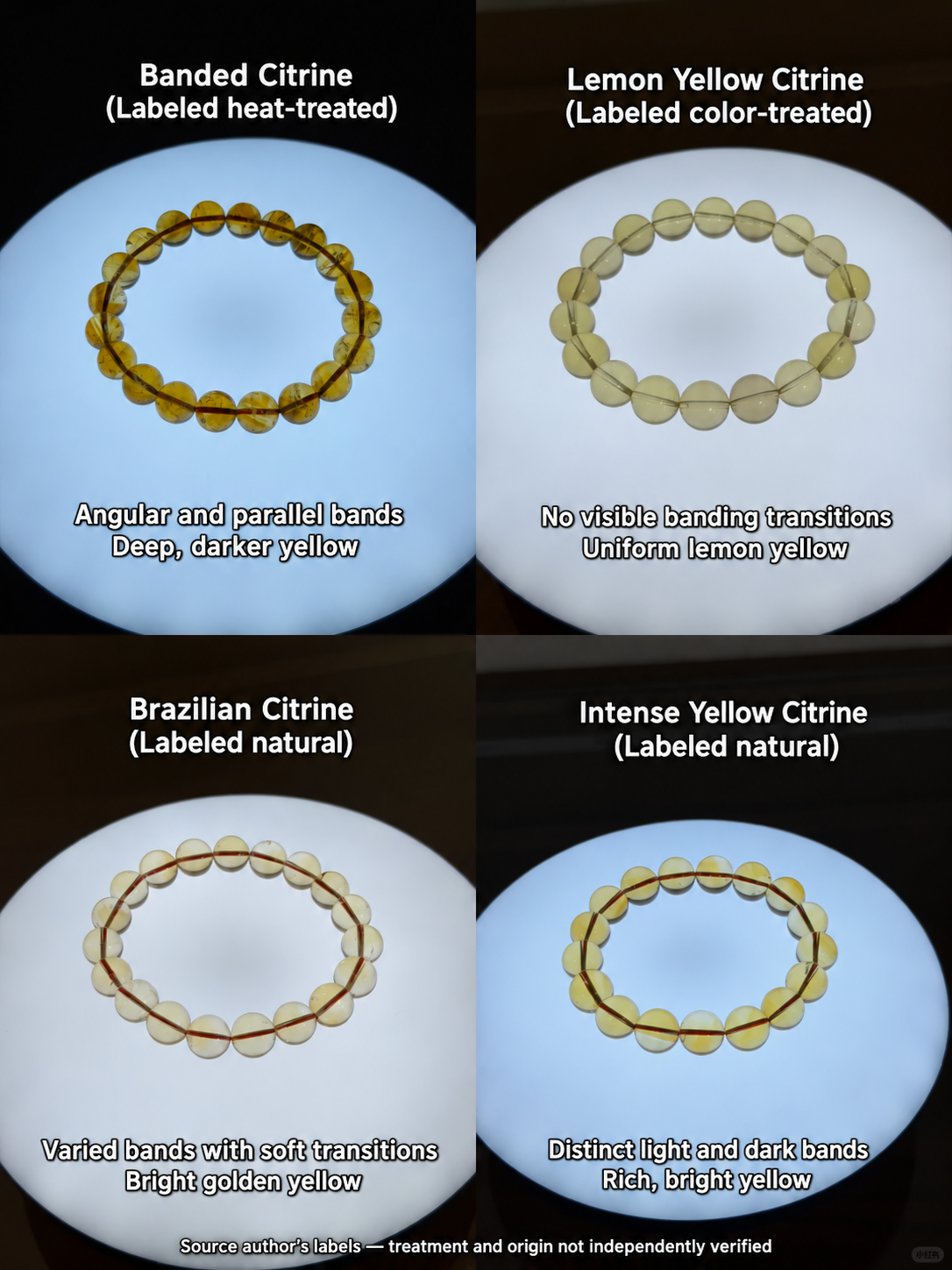
GIA describes heat treatment that changes amethyst’s color to produce citrine. Treatment, natural growth, and material identity are separate questions. An Intense Yellow Citrine label describes appearance; it does not establish how the color formed. [5]
Ask the seller what is known about treatment and what supports that answer. GIA identification reports describe material identity and detectable treatments. If a report is supplied, match it to the item and read its actual findings. An unknown treatment history should remain recorded as unknown. [6]
Match size weight and construction
Under Sylvanite’s post, several readers ask for bead diameter before discussing price. That is a useful first question. Record bead diameter, bead count, wrist fit, and total weight together. Two bracelets described as 10 mm may still contain different amounts of material. [3]
Keep the units clear: millimeters describe bead dimensions; grams describe weight. If metal charms or a clasp are included, ask whether the quoted weight includes them. A price per gram is useful only when the weights refer to comparable components.
A dated example from one retailer
On September 17, 2026, GemKrishna listed the following variants of the same citrine bracelet. The selected configuration was a 7-inch wrist, stretch elastic, and no paid ritual add-on. Prices are Indian rupees per bracelet, with taxes included as displayed. [8]
Swipe or scroll across to see all columns.
| Bead diameter | Listed price | Availability |
|---|---|---|
| 7.50–8 mm | INR 2,800 | In stock |
| 10 mm | INR 3,600 | In stock |
| 12–12.50 mm | INR 6,000 | In stock |
This is a size-variant comparison, not a fully matched valuation. The retailer did not provide variant-specific weights or treatment findings in the product details reviewed. Color and clarity were not independently measured. Its “AAA” label is the retailer’s description. The price difference cannot be attributed to bead size alone. [8]
Include the work and the setting
The guide also considers cut. For bracelets, compare bead shape, polish, drill holes, and edge finish. Record clasp and charm materials separately; an elastic strand and a precious-metal setting are different constructions. [2]
Keep a record before deciding
Use one column per offer. Keep missing information visible instead of filling it in from a photo or a market name.
Swipe or scroll across to see all columns.
| Record for each offer | Offer A | Offer B |
|---|---|---|
| Seller link and date checked | ________ | ________ |
| Price and currency per bracelet | ________ | ________ |
| Bead diameter and count | ________ | ________ |
| Wrist fit and total weight | ________ | ________ |
| Metal or charm weight included | ________ | ________ |
| Color under comparable lighting | ________ | ________ |
| Visible inclusions cracks and chips | ________ | ________ |
| Treatment disclosure and evidence | ________ | ________ |
| Round or faceted and finish | ________ | ________ |
| Metal type and clasp or cord | ________ | ________ |
| Report number and findings | ________ | ________ |
| Shipping taxes and return terms | ________ | ________ |
A high price still needs context
A reader under the guide asks about a 5,000-plus purchase, describing the size only as “15.” Another asks whether an item is natural. Without units, currency, and fuller specifications, those comments cannot support an appraisal. [2]
Is citrine always the most expensive quartz
That is Sylvanite’s opening question. The post and its comments are not a matched market survey, so they cannot establish a price ranking across quartz varieties. GIA describes citrine as sharing the affordability of many other quartzes. Compare specific pieces and disclosed qualities before drawing that conclusion. [3][4]
Avoid hot-water “authenticity tests.” GIA warns that sudden temperature changes can fracture citrine. Ask for disclosure and appropriate identification instead. [7]
Use the same checklist when browsing DrunkAngel’s citrine bracelets so you can ask about the details that matter to your choice.
Sources and references
Source addresses are provided as plain text. Numbered citations above refer to the entries below.
[1] Xiaohongshu — bracelet price comparison source post
https://www.xiaohongshu.com/search_result/6aa75434000000001103117b
[2] Xiaohongshu — buying-guide source post and reader questions
https://www.xiaohongshu.com/search_result/680e4740000000002300c791
[3] Xiaohongshu — Sylvanite source post
https://www.xiaohongshu.com/search_result/689d7729000000001c03c7e1
[4] GIA — Citrine Quality Factors
https://www.gia.edu/citrine-quality-factors
[5] GIA — An Introduction to Gem Treatments
https://www.gia.edu/gem-treatment
[6] GIA — Sample Colored Stone Reports
https://www.gia.edu/analysis-grading-sample-report-colored-stone
[7] GIA — Citrine Care and Cleaning
https://www.gia.edu/citrine-care-cleaning
[8] GemKrishna — natural citrine bracelet listing and size variants
https://gemkrishna.com/products/natural-citrine-bracelet-aaa-grade-8mm-beads-prosperity